Thursday, April 8, 2010

The Secret of Mark Twain and Joan of Arc

image Recommend this article... By Stephen K. Ryan

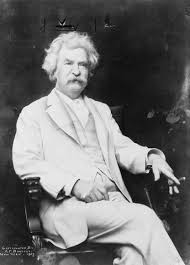
Mark Twain believed in the supernatural, apparitions, and loved a Catholic Saint.

Mark Twain, to the surprise of almost everyone, wrote a book, a biography no less, about the life and times of Joan of Arc. The book is call the "Personal Recollections of Joan of Ark" and astonishingly he called this virtually unknown volume his "best and favorite work".

Author Randall Sullivan told us recently in an e-mail
"Thanks for your letter regarding my book, The Miracle Detective. I was simultaneously stirred and chagrined by what you wrote about Mark Twain and his Joan of Arc book. I have to admit that I was among those who did not know that Twain had authored such a book, let alone that he considered it his most important work."

There are intriguing reasons why most folks are unaware of the beliefs of Mark Twain, but first here are the remarkable words from Mark Twain about a book he wrote about a Catholic Saint.

"I like Joan of Arc best of all my books; and it is the best; I know it perfectly well. And besides, it furnished me seven times the pleasure afforded me by any of the others; twelve years of preparation, and two years of writing. The others needed no preparation and got none."

Mark Twain admired, maybe even venerated “Joan of Arc" and he was transfixed by the amazing spiritual events experienced by the young French virgin who called herself "Joan the Maid"

Mark Twain spent twelve years researching and writing his book.

Twain went to the National Archives of France and read through the transcripts of the trial that ended in Joan's martrydom, as well as the inquisition — held 25 years after her death — that cleared her name. He studied both English and French accounts of the French heroine, and concluded, in an essay(read the entire essay here) he wrote in 1904 that Joan was the "Wonder of the Ages," an individual "stainlessly pure, in mind and heart, in speech and deed and spirit."

Mark Twain said:

“Taking into account, as I have suggested before, all the circumstances -- her origin, youth, sex, illiteracy, early environment, and the obstructing conditions under which she exploited her high gifts and made her conquests in the field and before the courts that tried her for her life, -- she is easily and by far the most extraordinary person the human race has ever produced".

"The most extrodinary person the human race has ever produced", certainly high praise for a Catholic Saint from Mr. Twain.

Edward Wagenknecht in his biography , "Mark Twain: The Man and His Work" said of Mark Twain's labor:

"It is an extraordinary (and baffling) literary phenomenon that Mark Twain, who was not disposed to see God at work in the melancholy affairs of men, should have been so galvanized by the life and achievement of this young woman that he devoted years of his life to this book about her."


Thomas Howard, Author, ""Chance or the Dance? weighed in with:

"Mark Twain comes furtively like Nicodemus at night with this tribute to one of God's saints. In doing so he tells a secret about himself. It is as though the man in a white suit and a cloud of cigar smoke thought there just might be a place where people in white robes stand in clouds of incense."

But it is in Mark Twain's remarkable essay where we see in his own words his special relationship and love for Joan of Arc:

"There is no blemish in that rounded and beautiful character.

She was deeply religious, and believed that she had daily speech with angels; that she saw them face to face, and that they counselled her, comforted and heartened her, and brought commands to her direct from God. She had a childlike faith in the heavenly origin of her apparitions and her Voices, and not any threat of any form of death was able to frighten it out of her loyal heart. She was a beautiful and simple and lovable character.

Her history has still another feature which sets her apart and leaves her without fellow or competitor: there have been many uninspired prophets, but she was the only one who ever ventured the daring detail of naming, along with a foretold event, the event's precise nature, the special time-limit within which it would occur, and the place -- and scored fulfilment.

At Vaucouleurs she said she must go to the King and be made his general, and break the English power, and crown her sovereign -- "at Rheims." It all happened. It was all to happen "next year" -- and it did. She foretold her first wound and its character and date a month in advance, and the prophecy was recorded in a public record-book three weeks in advance. She repeated it the morning of the date named, and it was fulfilled before night.

At Tours she foretold the limit of her military career -- saying it would end in one year from the time of its utterance -- and she was right. She foretold her martyrdom -- using that word, and naming a time three months away -- and again she was right.

At a time when France seemed hopelessly and permanently in the hands of the English she twice asserted in her prison before her judges that within seven years the English would meet with a mightier disaster than had been the fall of Orleans: it happened within five -- the fall of Paris. Other prophecies of hers came true, both as to the event named and the time-limit prescribed."

Finally one of our favorite passages from Twains' essay:

"asked at her trial why it was her standard (The standard depicts the Virgin Mary and two angels) had a place at the crowning of the King in the Cathedral of Rheims rather than the standards of the other captains, she uttered that touching speech, "It had borne the burden, it had earned the honor" -- a phrase which fell from her lips without premeditation, yet whose moving beauty and simple grace it would bankrupt the arts of language to surpass."

"Bankrupt the arts of language to surpass" Again high praise from one of America's finest writers.

But of course the main stream media will have none of Mark Twain's journey into the supernatural. The media, book critics , and academia have kept Mark Twain's views of this Catholic Saint a virtual secret for years. Most reviews of the book dismiss the work as insignificant.

Atheists, agnostics and "intellectuals" have employed Mark Twain's wit to ridicule organized religion for decades , they are beholden to this notion and so they are not about to sully the waters with a spiritual view of Mark Twain. The atheists love to quote Mark Twain's famous quip "It ain't those parts of the Bible that I can't understand that bother me, it is the parts that I do understand."

We have no doubt Mark Twain was quite scornful of many aspects of organized religion in his day. Who is not from time to time. The Ted Haggards, the Mark Stanfords, the Jimmy Swaggerts and all the hypocrits deserve to be pilloried.

But the Atheists, the purveyors of logic and reason, refuse to have a balanced view of Twain. They reverentially genuflect at Twain's derision of people of faith, but they quickly label him a fool when he finds beauty and virtue in a religious figure.

The Atheists can not accept Mark Twain's book about a Saint, as worthy of his talents, particularly a book about a Catholic religious figure that claims to have been guided by apparitions, angels and Saints.

Mark Twain was fully aware that Joan of Arc was exceptionally pious. She required her soldiers to take the Sacraments of Confession and Communion regularly and she would have her men of her army gather around for daily prayer and devotion. Mark Twain knew all this. He also understood that she believed all that she accomplished was possible only through God's intervention and to the dismay of the Atheists, Mark Twain does not quibble with any of her testimony.

She is the Wonder of Ages.

Below is a fascinating story of Mark Twain and "Joan of Arc" from the New York Times from 1905mark
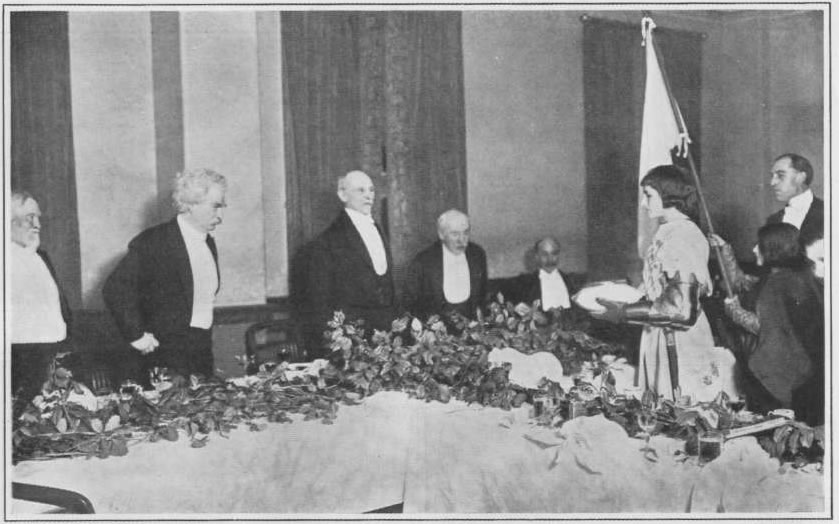
Left to Right: Andrew Carnegie, Mark Twain, Dan Beard, Sir C. Purdon Clarke, Rollo Ogden, Miss Angersten
This photo of the event appeared in the December 31, 1905 edition of The New York Times, Pictorial Section.

Mark Twain was the guest of honor at a dinner given last night at the Aldine Association by the Society of Illustrators. All the well-known magazine and newspaper artists were present, while other distinguished guests included Andrew Carnegie, Sir. C. Purdon Clarke, Caspar Whitney, Robert Collier, Jr., Norman Hapgood, Alphonse Mucha, Arthur Scribner, and Thomas A. Janvier, Frederick Remington, Henry S. Fleming, and Daniel Beard were on the Reception Committee.

It had been arranged that when the humorist arose to speak Miss Angersten, a well-known model, was to appear in the garb and with the simple dignity of Jean d'Arc, his favorite character in all history. He was on his feet as Jean d'Arc entered the room. She wore the armor of the French heroine and her hair and face made a strangely appealing picture.

The face of the humorist, which had been wearing its "company" smile all night, suddenly changed. He had every appearance of a man who had seen a ghost. His eyes fairly started out of his head, and his hand gripped the edge of the table.

Jean d'Arc presented him with a wreath of bay. He merely bowed, with his eyes fixed on the girl's face. They followed her as in reverent silence she passed out, followed by a little boy in suitable costume, bearing a banner over her head. Then Mark Twain spoke. His voice was broken, and his word came slowly.

There's an illustration, gentlemen - a real illustration," he said. "I studied that girl, Joan of Arc, for twelve years, and it never seemed to me that the artists and the writers gave us a true picture of her. They drew a picture of a peasant. Her dress was that of a peasant. But they always missed the face - the divine soul, the pure character, the supreme woman, the wonderful girl. She was only 18 years old, but put into a breast like hers a heart like hers and I think, gentlemen, you would have a girl - like that."

The humorist looked toward the door, and there was absolute silence - puzzled silence - for many did not know whether it was time to laugh, disrespectful to giggle, or discourteous to keep solemn. The humorist realized the situation. Turning to his audience he came out of the clouds and said solemnly:

"But the artists always paint her with a face - like a ham."

Monday, April 5, 2010

Ernest Hemingway's Nobel promise to the Virgin Mary

By Stephen K. Ryan

imageErnest Hemingway's hero, Santiago, the fishing captain from his famous book, Old Man and the Sea, prays: Hail Mary, and Our Father. These are the prayers Santiago recites ‘should I catch this fish’. Santiago also promises to make a pilgrimage to the Virgin De Cobre (Our Lady of Charity from Cuba) if he catches the fish.

Furthermore, The Virgin De Cobre and the Scared Heart of Jesus: Pictures of both the Virgin De Cobre and the Scared Heart of Jesus are the only adornments in Santiago’s shack. The pictures were the relics of the late wife of Santiago.

Most folks are familiar with the religious and Catholic overtones of Old Man and the Sea, but few are aware of the connection to Santiago's fictional promise to the Virgin De Cobre and Hemingways' authentic gift to the Virgin Mary. It is likely Ernest Hemingway made the same promise to himself that Santiago made, "if he should catch this fish". After winning the Nobel Prize for literature in 1954, (which he won for writing The Old Man and the Sea,) clearly the big fish - the prize he had pursued, he made his own pligrimage to the shrine of Caridad del Cobre in Cuba and offered his Nobel prize award, a medallion, to the Blessed Virgin Mary.

Interestingly this was not the first time Ernest Hemingway had the Virgin Mary on his mind. Years before giving up his Nobel Prize to the Virgin De Cobre, Hemingway had gone to the bullfights in Zaragoza, Spain. It was there that he witnessed the Pilar shrine.

Our Lady of the Pillar is the name given to the Blessed Virgin Mary for her claimed appearance in Spain. Her shrine that moved Hemingway is in the Basilica of Our Lady of the Pillar in Zaragoza, by the river Ebro. According to legend, in the early days of the Church, the Apostle James the Greater was evangelizing the Gospel in Caesaraugusta, but his mission was making little progress until miraculously, he saw Mary committing him to Jerusalem. In his vision, she was atop a column or pillar, which was being carried by angels. That pillar is believed to be the same one venerated in Zaragoza today. Miraculous healings have been reported at the scene. This is the only known apparition of Mary to have occurred before her Assumption.

After Hemingway's time in Spain he returned to the States and bought a fishing boat. The boat which would eventually inspire him to write "Old Man in the Sea" was named Pilar. Hemingway's beloved boat was named after the apparitions in Zaragoza.

Hemingway's famous boat is now a popular tourist destination in Cuba.

Very interesting story of Our Lady of CharityfromWikipedia.

Our Lady of Charity(Spanish: "Nuestra Señora de la Caridad del Cobre" or simply "La Caridad Del Cobre") is a 17th century Roman Catholic Cuban miraculous statue of the Virgin Mary. Intensely popular amongst the Cuban people, she has been proclaimed patroness of Cuba by the Catholic Church. A shrine dedicated to Our Lady of Charity is located in the mining town of El Cobre, outside Santiago de Cuba. In Santería, the goddess Ochún has been syncrenized with her. She is nicknamed "Cachita" by Cubans. Her feastday is on September 8.

Contents

[hide]

[edit]History

The story behind the La Virgen de la Caridad del Cobre, happened around 1608 (sometime between 1604 and 1612 depending on the source). Two brothers, Rodrigo and Juan de Hoyos, and their slave, Juan Moreno, set out to the Bay of Nipe for salt. They are traditionally called the "three Juans". They needed the salt for the preservation the meat at the Barajagua slaughter house, which supplied the workers and inhabitants of Santiago del Prado, now known as El Cobre. While out in the bay, a storm arose, rocking their tiny boat violently with restless waves. Juan, the slave, was wearing a medal with the image of the Virgin Mary. The three men began to pray for her protection. Suddenly, the skies cleared, and the storm was gone. In the distance, they saw a strange object floating in the water. They rowed towards it as the waves brought it towards them. At first they mistook it for a bird, but quickly saw that it was what seemed to be a statue a girl. At last they were able to determine that it was a statue of the Virgin Mary holding the child Jesus on her right arm and holding a gold cross in her left hand. The statue was fastened to a board with an inscription saying "Yo Soy la Virgen de la Caridad" or "I am the Virgin of Charity." The statue was dressed with real cloth and the Virgin had real hair and skin of a mixed woman. Much to their surprise, the statue remained completely dry while afloat in the water.

Preserved in the General Archive of the Indies of Seville, a testimony of Juan Moreno, given in 1687, says the following:

“Having camped in the French Key, which is in the middle of the Bay of Nipe, waiting for a good time to leave for the salt mines, being a morning of calm seas, they left the French Keys, before daybreak. The aforementioned Juan y Rodrigo de Hoyos and myself, embarked in a canoe, headed for the salt mines, and far from the French Key we saw something white above the foam of the water, which we couldn’t distinguish. As we got closer, birds and dry branches appeared. The aforementioned Indians said, 'It looks like a girl.' While they were discussing, they saw an image of Our Lady, the Holy Virgin, on top of a small wooden plank, holding the baby Jesus in her arms. On this small tablet, was written in large letters, which read , 'I am the Virgin of Charity.' Looking at her clothes, they realized that they were not wet. In seeing this, full of joy they each took only one third of salt and went to Barajagua."

A series of articles on
Roman Catholic
Mariology

General articles
Overview of Mariology
Veneration of the Blessed Virgin History of Mariology

Key Marian apparitions
(approved or worthy of belief)
Guadalupe Miraculous Medal
La Salette Lourdes Pontmain Laus Banneux Beauraing Fátima Akita

Expressions of devotion
Art Music Architecture

Specific articles
Apparitions Saints Popes Dogmas and Doctrines Movements & Societies

Overjoyed by what they had discovered, they collected only a third of the salt they were supposed to collect and hurried back to Barajagua. They showed the statue to a government official, Don Francisco Sánchez de Moya, who then ordered a small chapel to be built in her honor. One night, Rodrigo went to visit they statue, but discovered that the image was gone. He organized a search party, but had no success in finding Our Lady of Charity. Then, the next morning, she was back on the altar, as if nothing had happened. This was inconcievable as the chapel had been locked. This event happened three times. The people of Barajagua came to the conclusion that she wanted to be in a different spot, so they took her to El Cobre. She was received with much joy in El Cobre, and the church there had its bells ring on her arrival. It was at this point that she became known as "Nuestra Señora de la Caridad del Cobre" or "Our Lady of Charity of El Cobre". Much to the dismay of people in El Cobre, the disappearance of the statue continued to happen.

Original statue of Our Lady of Charity, located in the Sanctuary of El Cobre

One day, a young girl named Apolonia was playing outside, pursuing butterflies and picking flowers. She went towards the mountains of the Sierra Maestra, where she came across the statue on top of a small hill. There were those who did and those who did not believe the little girl's testimony, but in the end, the Virgin was taken to the spot of her discovery, where a church was erected for her. The story circulated around the island quickly. Many feel that the Virgin purposely chose to have her sanctuary in El Cobre because it is located inOriente, a province that no longer exists due to communism. The nature there is the most stunning in Cuba, with its mountains, beaches, rivers, and thick forests. It was in Oriente that the first settlement in Cuba was made, Baracoa; it was in Oriente where the slaves were set free for the first time in 1868; it was in Oriente where Cubans first began to revolt against the Spaniards.

At the request of the veterans of the War of Independence, Our Lady of Charity was declared the patroness of Cuba by Pope Benedict XV in 1916 and solemnly crowned in theEucharistic Congress held in Santiago de Cuba in 1936. Pope Paul VI raised her sanctuar

Sunday, March 28, 2010

Wake up Catholic Press - Medjugorje News - It's Bigger than you Think

By Stephen K. Ryan

With the twin towers of Vatican news the past few days concerning the mysterious town called Medjugorje where alleged apparitions are said to be occuring, it is time for American Catholic press to understand they have been consistently wrong on the reporting of the events taking place there and have also held a negative bias.

Two recent colossal reports from Rome hopefiully shocks the cozy Catholic news rooms, filled with journalists who have shied away from reporting fairly about the intriquing happenings in Medjugorje, into action. Now that the Vatican has decided to investigate Medjugorje we think it is also time for the Catholic press to open thier minds to the phenomenon.


The News


Last week the Vatican, rather dramatically, announced that an inquiry into the alleged apparitions at Medjugorje will be led by the Congregation for the Doctrine of Faith. According to experts The Holy See has never investigated nor pronounced a judgement on a case of apparitions that are still in progress. This is not insignificant news.

Then as reported by highly respected Italian journalist AndreaTorielli, (click here to read more) Rome has decided that the diocese that oversees Medjugorje will soon be moved and the Bisop who holds negative views on Medjugorje will be stripped of his authority to control the activities of the Pilgrims and Visionaries. This may have a profound effect on Catholics around the world many who have kept a distance from Medjugorje due to the Bishop's negative views.

Tornielli wrote that the decision to create the new diocese,, was nearly made last September, but was put off in part by the opposition of Bishop Peric. Last year American Catholic press almost universally reported the activities in Medjugorje at that time as a precursor to a soon to be announced negative judgement against Medjugorje. Without question those opposed to the authenticity of the Medjugorje apparitions of "Our Lady" known as the Queen of Peace have hung their hat on Bishop Peric's negative views of the mysterious events. We see it everyday on our website, in posted comments, e-mails, and social networking activity, posts to Twitter and Facebook.

Medjugorje has been split down the middle by Bishops Peric's views. This will of course no longer be the case. Based on yesterday's news of Bishops Peric's potential lost authority over Medjugorje, a major reset button has now been pushed by the Vatican.

If ministryValues.com seems a little sulky we think we have earned that right. After all, we and others have simply been making the case that Medjugorje is a very fascinating phenomenon, and an interesting news story that sooner or later will become a big deal. It has now become a big deal.

Since Ministryvalues.com began to follow the events of Medjugorje we have at times felt pushed aside and viewed as a group lurking in the fringes of Catholic News. Attempting to have conversations about Medjugorje with Catholic Journalists and prominent bloggers we were made to feel like we were talking about Cousin "It" who lived in the Adams family attic. Despite our attempts to communicate to American Journalists that great intellects and spiritual leaders of our faith including Pope John Paul II and now Cardinal Schonborn have been fascinated by Medjugorje, and have spoken highly of its great"fruits" we would be met with a shug of the shoulder, subtle language insinuating that Pope John II had a "Mary" problem, and a quick dismissl of our inquiry. Many viewed us simply as "evangelists for Medjugorje" and not as serious reporters.

Notwithstanding what great men have had to say about Medjugorje, the U.S. Catholic press, not really grasping their own logic, would simply stand behind Bishop Peric's negative views of Medjugorje as if he were Pope and reject Medjugorje out of hand.

Ministryvalues.com's greatest frustration came from the push back we would get from journalists who would condescendingly say to us that the Church has already ruled on Medjugorje and that it is not supernatural and therefore there was no need for anymore conversation.

Particularly disappointing was how often reporters would not hesitate to write authoritatively on the subject despite an ankle deep understanding of the official Church position on Medjugorje . The Vatican has not ruled one way or the other on the supernatural aspects of Medjugorje and journalists have ignored the obvious fact that MILLIONS of "pilgrims" including Bishops and Cardinals have gone there with the Vatican being very aware of this fact. The Catholic press seemed at times to be the only folks oblivious to the phenomenon and when reporting on the matter they simply got it wrong most of the time. Hopefully now that will begin to change.

Pope John Paul II "Medjugorje - The Spiritual Heart of the World"

By Daniel Klimek

Pope John Paul II once powerfully observed, "Today's world has lost its sense of the supernatural, but many are searching for it - and find it in Medjugorje, through prayer, penance, and fasting." The late pontiff and future saint, his holiness, spoke these words on August 1, 1989, while addressing a group of Italian physicians studying the apparitions in Medjugorje with medical and scientific investigations.

It is no secret within Rome that John Paul II absolutely loved Medjugorje, once even acquiring the nickname "Protector of Medjugorje" within the Vatican. Even eminent American intellectuals were no strangers to this reality. The great Franciscan intellectual, Fr. Benedict J. Groeschel, himself an investigator of supernatural phenomena, once admitted about John Paul II in a revealing interview: "I can tell you for a fact that the pope loves Medjugorje from afar and would go there in a minute if the theologians would let him."

While it is known that the late Polish pope never personally visited Medjugorje, what is less known is that throughout the last two decades of his life Pope John Paul II held personal meetings and correspondences with Medjugorje visionaries, Medjugorje priests, even Medjugorje inner locutionaries, and numerous pro-Medjugorje bishops. His enthusiasm and love for Medjugorje's mystics was overwhelming and filled with abundant respect and a joyful beauty overcome with hope. One such example is when Medjugorje visionary, Mirjana Dragicevic Soldo, met with John Paul II. She once shared the details behind this poignant, and somewhat humorous, encounter while addressing a group of pilgrims:

"I personally had a such a great honor to be able to speak with late Pope John Paul II. That was so beautiful. I was in St Peter's Basilica in Rome with all other pilgrims. Pope as he was walking by, he was blessing everybody. He blessed me and just walked away. And then this Italian priest I was with said ‘Holy Father, this is Mirjana from Medjugorje.' He came back, blessed me again and he left. And I said to this priest, ‘Father, you see he just thinks that I need a double blessing' [laughter]. However, in the afternoon we received an invitation tomorrow morning to come to Castelgondolfo, close to Rome in order to talk to Holy Father. I don't have to tell you that I couldn't sleep all night. Tomorrow when I reached the place, he saw that I was so excited. We were alone and then he started talking to me in Polish. He thought I would understand because both are Slavic languages. He wanted to make me feel comfortable but I didn't understand a word because it's not even close to our language. However, I was crying and I couldn't catch a breath to say a word. So when I finally succeeded to say a word, I said ‘Holy Father, can we try in Italian ?' [laughter]. Then we talked and among other things he said to me, ‘If I were not Pope, I would be in Medjugorje a long time ago. I know everything, I have been following everything. Ask pilgrims to pray for my intentions. And take good care of Medjugorje because Medjugorje is the hope for the entire world...' "

Beyond such personal words of encouragement and trust for the visionaries and the fruits of faith at Medjugorje, Pope John Paul II frequently displayed his appreciation in officially signed papal blessings as well. Two such official blessings were given by John Paul II to Fr. Jozo Zovko, O.F.M., the pastor in St. James Church at Medjugorje when the apparitions began, and to Vicka Ivankovic, one of the Medjugorje visionaries who still receives daily apparitions. Vicka, like Mirjana, has also personally met with the Holy Father in Rome, exchanging gifts and warm sentiments of faith. The official blessing she received from the late pope hangs on her wall, beautifully framed, in her home.

Fr. Jozo met with Pope John Paul II in 1992, in the midst of the wars in the former Yugoslavia. John Paul II's words to Fr. Jozo were striking: "I am with you, protect Medjugorje! Protect Our Lady's messages!" The passion and urgency of the Holy Father's words for the protection of Medjugorje make clear how much the holy site, as to millions of Catholics, meant to him.

That Our Lady is appearing in Medjugorje, the Holy Father had little doubt about. The papal blessing he signed and gave to Fr. Jozo read:

"I grant from the heart a particular blessing to Father Jozo Zovko, o.f.m. and I invoke a new outpouring of graces and heavenly favors, and the continuous protection of the Blessed Virgin Mary. Joannes Paulus II."

The Holy Father's own knowledge of Medjugorje and the major figures surrounding the events there was very impressive. Often his knowledge extended beyond the facts that many Medjugorje devotees may even know. For instance, most Medjugorje followers know that there are six visionaries. However, fewer may know that, in addition to the original six children who reported experiencing apparitions of Our Lady in 1981, two also reported experiencing interior locutions (locution cordis), the mystical grace of seeing and hearing Our Lady in an interior way - through the heart, especially when in prayer. Jelena and Marijana Vasilj, distant cousins, were the two youngsters who reported experiencing this grace. At Medjugorje, they acquired the nickname of "the seers of the second generation," being ten year-old girls (compared to the older visionaries) during the beginning periods of the apparitions.

Of course, such idiosyncratic distinctions, between young mystics who received apparitions and those who received inner locutions-while perhaps a bit perplexing to many observers-were no problem for John Paul II to discern. He didn't miss a beat. In 1988, John Paul II received a group of Croatian Catholics into his private chapel in Rome. He instantly recognized two members of the group from photographs he had witnessed. Approaching the two young girls, he said, "Ah yes, Jelena and Marijana, who have the interior locutions." John Paul II greeted the girls warmly and stared into their eyes for some time with much amusement.

Today, both Jelena and Marijana are, of course, mature women. Jelena's path has especially been interesting. Traveling to the United States for her undergraduate studies, she completed her B.A. at the Franciscan University in Steubenville, Ohio. Shortly thereafter, Jelena returned to Rome where she pursued a doctorate in theology at the Gregorian University, always displaying a sophisticated mind with a deep appreciation for the Catholic faith.

Only two years after the pope met with "the seers of the second generation," John Paul II sent his friend and confidant, Bishop Paul Hnilica, S.J., then Auxiliary Bishop of Rome, to accompany Marija Pavlovic, another Medjugorje visionary, on a visit to Russia. Bishop Hnilica continually told Marija how much the pope wished to visit Medjugorje. Similarly to the words John Paul II gave to visionary Mirjana Soldo during their meeting, the Bishop emphasized how the Holy Father explained to him: "If I wasn't the Pope, I'd be in Medjugorje already!"

Many bishops from around the world have had similar encounters with John Paul II on the topic of Medjugorje. In June 1986, in response to a group of twelve Italian bishops seeking advice on pilgrims traveling to Medjugorje, the pope recognized the indisputable fruits of faith present in the village: "Let the people go to Medjugorje," he said, "if they convert, pray, confess, do penance and fast."

Similarly, in April 15, 1990, theNational Catholic Reporter quoted Bishop Michael D. Pfeifer of San Angelo, Texas. Bishop Pfeifer explained:

"During my Ad Lumina visit to Rome with the Bishops of Texas in April 1988, I asked our Holy Father his opinion about Medjugorje during the private conversation I had with him. He spoke very favorably about the happenings there, pointing out the good which had been done for people. During the lunch which the Texas Bishops later had with the Holy Father, Medjugorje came up for further discussion. Again His Holiness spoke of how it has changed the lives of people who visit it, and said that so far the messages are not contrary to the Gospel."

Likewise, during his Mass Homily at the Notre Dame Conference on Medjugorje delivered on May 14, 1989, Bishop S. Treinen, Bishop of Boise, Idaho, related a conversation he once had with John Paul II:

"In the course of it [our conversation] I said: ‘Holy Father, I have just come from Medjugorje. There are wonderful things going on there.' The Pope replied: ‘Yes, it's good for pilgrims to go to Medjugorje and pray and do penance. It's good.' That's first hand, I heard him say it myself."

In February 1990, Bishop Murilo Krieger, then Auxiliary Bishop of Florianopolis, Brazil, reported a conversation with John Paul II about the apparitions, wherein the pope enthusiastically told him: "Medjugorje is a great center of spirituality!" Not only that but the Holy Father also happily assented to Bishop Krieger's request, giving his papal blessings to the visionaries. Bishop Krieger explained:

"In 1988, I was with eight other bishops and thirty three priests on spiritual retreat in the Vatican. The Holy Father knew that many of us were going to Medjugorje afterwards. After a private mass with the Pope, before leaving Rome, he said, without having been asked anything, ‘Pray for me in Medjugorje.' On another occasion, I told the Pope ‘I am going to Medjugorje for the fourth time.' He concentrated his thoughts and said, ‘Medjugorje, Medjugorje, it`s the spiritual heart of the world.' On the same day I spoke with other Brazilian bishops and the Pope at lunch time and I asked him: ‘Your holiness, can I tell the visionaries that you send your blessing?' He answered: ‘Yes yes,' and embraced me."

In addition to Pope John Paul II's overwhelming support, in recent years Medjugorje has acquired some very influential supporters in Roman Catholic circles. Critics of Medjugorje, from the bishop of Mostar to German theologian Manfred Hauke, are given a lot of media attention. But what is noteworthy is how many cardinals have voiced their affection for the shrine, including Cardinals Tonini Ersilio, Emmanuel Wamala, Jean Margeot, Frantisek Tomasek and, most recently, his eminence Christoph Cardinal Schonborn, the Archbishop of Vienna who visited Medjugorje as a pilgrim for Christmas 2009. Even theologians have shown their appreciation. The French theologian Fr. Rene Laurentin and the Swiss theologian and cardinal Hans urs von Balthasar have been open Medjugorje supporters. Balthasar, in addition to being arguably the most eminent theologian of the twentieth century, is also known for co-founding-with his friend Joseph Ratzinger (the current Pope), and with others-the Catholic journalCommunio. He frequently referred to the events happening at Medjugorje as "a theater of holiness."

Most recently, the popular American priest, Fr. Donald Calloway of the Marians of the Immaculate Conception, published his autobiography, No Turning Back: A Witness to Mercy. Fr. Calloway is the vocation director for the Marians of the Immaculate Conception, the author of numerous books, and a leading proponent of the Divine Mercy devotions of St. Faustina Kowalska. It was a book about Medjugorje, The Queen of Peace Visits Medjugorje, which led to Calloway's famous conversion, going from an agnostic and destructive youth wrestling with addiction, promiscuous sex, and illegal crime to someone who found hope, peace, and meaning in Medjugorje, leading to the priesthood and to his current life of spiritual maturity and personal unity with Christ and Our Lady.

The messages and fruits of Medjugorje have reached an innumerable amount of people. From the faithful millions who have visited the village to the millions who have read about it, to some of the most influential members of the Catholic Church. Pope John Paul II, who many Catholics believe was a mystic himself, had a special relationship (in his immense spirituality and in his devotion to Our Lady) with Medjugorje. He asked others to protect Medjugorje and he believed that Medjugorje was the fulfillment of Fatima.

Monsignor Angelo Kim, President of the Korean Bishops' Conference, once wrote about his encounter with John Paul II in the Korean national weekly newspaper,Catholic News,in 1990. Prior to the conclusion of the last Bishops' Synode in Rome, the Korean bishops were invited to a lunch with John Paul II. Msgr. Kim addressed the Holy Father directly and said, "Father, thanks to you, Poland was able to liberate itself from Communism." To this, the Holy Father responded, "No, this is not my merit. This is the work of the Blessed Virgin Mary, as She had predicted in Fatima and in Medjugorje."

As mentioned, in the Vatican he was known as the "Protector of Medjugorje." In reality, this relationship was mutual. According to the testimony of the Medjugorje visionaries, on May 13, 1982, on the anniversary of the Fatima apparitions and on the occasion of an assassination attempt on John Paul II's life, Our Lady said, "His enemies tried to kill him, but I have protected him."

Medjugorje and the Pope’s Hail Mary Pass to the Virgin Mary

By Stephen K. Ryan
"Hail Mary Full of Grace the Lord is with you." The words are part of a short prayer, a prayer about the Virgin Mary and Catholics are taught early on that this magical little appeal contains a mysterious power against evil. We are told to pray the rosary because the words defend us against Satan and the prayer promises us protection "at the hour of our death". In times of trouble, the Catholic Church encourages the faithful to look to Mother Mary, to seek her "whispering words of wisdom".
Perhaps not at its hour of death, but by all accounts the Catholic Church today is in need of help. Recently, the Church has taken a historic pounding and it now finds its back against the wall and no doubt it must feel in trouble and under siege. For many, it seems, an evil has descended and it is engulfing the Catholic faith. A Bishop in Ireland suggested that because of the sex abuse crisis - a scandal that is shaking the very foundations of the Catholic Church - it could take generations to repair the damage to the Church's reputation.

In the past days we have seen the child abuse crisis explode around the world, most ominously in Germany, to the point it may be reaching a sitting Pope. For those who spend anytime following events of the Catholic Church, online and in the news, clearly it seems "Evil" is everywhere and running rampant. It is in cyberspace, inside the Vatican, in faith based press and the Mainstream media. Everywhere we turn we encounter Lucifer, exorcists, "satanic smoke", demons and devils. For the Church, darkness, death and sex scandals seem to lurk in all corners of the world, and now even the Prince of Darkness himself, Christopher Hitchens, sensing blood on the streets, has come forward with his lance, hoping to fatally spear the head of the Catholic Church. Swinging his mighty pen, he has come to eternally define the Pope as evil incarnate.
Christopher Hitchens predictably hammers away in Slate.com in an article called the Great Catholic Cover-Up with the catchy tag line "The pope's entire career has the stench of evil about it." He writes: "The chief exorcist of the Vatican, the Rev. Gabriele Amorth (who has held this demanding post for 25 years), was quoted as saying that "the Devil is at work inside the Vatican," and that "when one speaks of 'the smoke of Satan' in the holy rooms, it is all true-including these latest stories of violence and pedophilia." This can perhaps be taken as confirmation that something horrible has indeed been going on in the holy precincts."
In response to this tsunami of bad publicity, publicity that is creating genuine crises for the Catholic Church, the Vatican, in dramatic fashion this week, perhaps desperately, perhaps divinely, has turned to Mother Mary seeking her protection against an evil that is relentlessly attacking the faith. In these times of trouble, the Vatican is turning to Mary for help and they think they may have found her in a small village town called Medjugorje. In Medjugorje, in southwestern Bosnia, apparitions of the Virgin Mary are said to be taking place, and Rome in a stunning development this week, at a time when they are in broiled in a worldwide crisis, announced, very publicly, unusual for this kind of thing, that they have formed a special commission to finally investigate the controversial apparition site.

This is the first time in Church history an investigation of an apparition site of the Virgin Mary has been handled directly by the Congregation for the Doctrine of Faith while the visions are still taking place. Make no mistake about this - this is a big deal.


We wonder: Is there no time left on the clock? Is it fourth and long, and the Catholic Church is now dropping back to throw one last giant Hail Mary pass. This time is the pass going to the Virgin Mary herself, in the sense that the Church is opening up an investigation into a real live apparition of the Madonna. Are they hoping for a miracle? Or has the Church, as penance for its sins, in a mysterious way, been asked to pray a unique form of the Hail Mary. Is the entire body of the Catholic clergy seeking forgiveness for its sins by looking to the Mediatrix, to Our Lady, the Blessed Virgin Mary, who points the way to her Son by participating in a collective pilgrimage to the foothills by a town called Medjugorje? In Medjugorje, it has been claimed, and many believe, the Virgin Mary has come to earth to encourage the world to reconcile with God, She asks us to convert, 'to put God in the first place in our lives" and to seek forgiveness from her Son.

She says quite simply, above all, “I have come to tell the world that God exists”.

An international commission of inquiry headed by Italian Cardinal Camillo Ruini – a top adviser to the late Pope John Paul II – has been formed to study the case of alleged apparitions and report back to the Congregation for the Doctrine of the Faith, the Vatican said in a statement Wednesday. The Medjugorje apparition has been disputed from the first days beginning in 1981. Nearly thirty years ago six youths said they had regularly seen visions of the Virgin in Medjugorje. Distinct for Fatima in Portugal or Lourdes in France, the Vatican has been cautious about declaring the sightings authentic. Rome, despite millions of visitor to the town, has not formally approved Medjugorje as an official shrine site.
But that fact has not kept the faithful pilgrims from flocking to Medjugorje. For many Medjugorje is no longer a place or town but an idea and a hope. John Paul II said of Medjugorje "It is the spiritual heart of the world" Medjugore is most famous for its "messages" messages that are said to come from Heaven delivered to six "visionaries" by the Virgin Mary herself, the "Queen of Peace" as she is known by the devoted. We are told by the "seers" who literally receive her "whispering words of wisdom" to seek "peace in our hearts" and to convert back to God. For years, those devoted to Medjugorje's simple message of peace, including Bishops, Cardinals and the "millions" of lay faithful have asked, even pleaded, that the Church look into the authenticity of the apparition of Medjugoje. They pointed to the enormous "good fruits" of Medjugorje as a sign that the apparitions are true and that the town is worthy of a special status as a "Holy Shrine".
During a week that seemed to encompass the Catholic Church with “the stain of evil” it is curious that the Vatican announced its investigation into the apparition site that many call "the spiritual lung of the world" at the height of the storm. We are not sure of course if this was a coincidence but it is interesting to note that on the same day of the announcement of the Vatican inquiry, mainstream media filled there papers and blogs with stories asking if the Pope would be forced to resign.
Is there a secret force behind the sudden announcement to open up the investigation into the apparition? Some see Cardinal Schonborn, the Archbishop of Austria's hands in the developments. He is a close confidant of Pope Benedict XVI, and an esteemed scholar. The Cardinal visited Medjugorje over New Year's, sparking a minor diplomatic incident and international headlines since official church pilgrimages to Medjugorje are barred. In his visit to Medjugore, Schoenborn told reporters that he traveled to the shrine in a private capacity. But he celebrated Mass there, met with the visionaries and granted several interviews afterward. To a reporter and speaking of Medjugorje the Cardinal asked "Who can make this up." He called the Blessed Mother "The best pastoral theologian" He also said that the spirit of Medjugorje a tree that has "bore many fruits," in terms of vocations, conversions and rediscovery of faith.
His activities in Medjugorje prompted the local bishop of Mostar, Monsignor Ratko Peric, to write him a letter Jan. 2, sharply criticizing his visit and suggesting that his "presence there was by no means a formal recognition of the apparitions."
Schonborn after returning from his very public visit to the apparition site again made international headlines by calling for an "unflinching examination" into the causes of sexual abuse by priests including what role celibacy contributes to the problem.
Is the fearless Archbishop, Cardinal Schonborn, the friend and protégé of Pope Benedict XVI, a man who believes the Virgin Mary is supernaturally speaking to the world, the secret power behind the Churches decision to investigate the mysterious phenomenon in Medjugorje? Some believe he is, and some also believe that potentially the investigation could lead to the most important event in the history of the Catholic Church since the birth of Christ..
It has been said Heaven is calling in Medjugorje. And now with all that has happened to the Catholic Church in the past few week and months, many are hoping and asking "Is the Church ready to listen?

First Time Ever Vatican to Formally Investigate Apparition Site While Ongoing

Daniel Klimek March 18, 20

The recent announcement by the Vatican to investigate the nearly 30-year long phenomena of Medjugorje is striking. The international commission to be led by Cardinal Camillo Ruini is in many ways groundbreaking. This constitutes the first time in Church history wherein the highest office of the Holy See will investigate an ongoing apparition site. Normally, it is custom for Church authorities to wait until the reported supernatural phenomenon concludes before passing judgment on the matter. With the Church’s aggressive exception (and decision) of placing Medjugorje under an investigative commission within the Congregation for the Doctrine of the Faith, it becomes clear that Vatican officials are recognizing what a significant and serious event Medjugorje is for the faithful on a global scale, no longer able to ignore its impact and influence on world Catholicism.

Professor Sandra L. Zimdars-Swartz, who has been one of the few scholars to write an academic book on modern Marian apparitions, once explained: “Of the hundreds of apparitions that have come to the attention of Roman Catholic authorities in the past two centuries, seven were investigated by diocesan commissions, were approved by the local bishop and went on to gain international attention: Rue du Bac (Paris, France, 1830), La Salette (France, 1846), Lourdes (France, 1858), Pontmain (France, 1870), Fatima (Portugal, 1917), Beauraing (Belgium, 1931-1933), and Banneux (Belgium, 1933).”

Already, by comparison, we can see what a historic recognition Medjugorje has achieved. Due to its unique status of becoming a global phenomenon, Medjugorje may become the first apparition to be approved by an international Church commission, instead of a diocesan commission, being elevated to a higher authority for judgment and solidifying its special status in Catholic affairs. What is especially significant is that a commission under the Congregation for the Doctrine of Faith was assigned to the task of investigating the apparitions. This speaks highly to Medjugorje’s importance within Vatican circles and the international community.

The Congregation for the Doctrine of Faith is the most influential office within the Roman Curia, constituting the Pope’s right hand, so to speak. The fact that a commission was assigned under the CDF to investigate Medjugorje’s significance hints at the possibility that the decision may have come from the highest level of power, from Pope Benedict XVI himself. Interestingly, this would not be the first time that the German pontiff and the CDF provided intervention for the apparitions in Medjugorje and their investigations.

The CDF has had a history of intervening with poorly conducted investigations on the diocesan level in Medjugorje. For years, influential Church officials in Rome have not been proud of how ineptly the events in Medjugorje have been scrutinized by certain local bishops. Therefore, even Cardinal Joseph Ratzinger himself, before becoming the current Pope, once played a crucial role in saving Medjugorje from incompetent and distorted investigations on the diocesan level, guiding the proceedings toward the more reliable hands of the Holy See.

In April 1986, then Bishop of Mostar, Pavao Zanic, who had an infamous reputation for hostility toward the apparitions and the visionaries, frequently making slanderous and unsubstantiated remarks against them, traveled to Rome to submit the findings of an episcopal commission he led investigating the events in Medjugorje. Bishop Zanic was more than surprised when he was summoned to a meeting with Cardinal Ratzinger in Rome, then the head of the Congregation for the Doctrine of the Faith. Cardinal Ratzinger ordered Zanic to suspend his judgment on the matter, dissolve his commission, and place the inquiry into the hands of the Vatican. The CDF made sure to free Zanic and his commission from further investigative duties, recognizing that he was not the man to objectively investigate the matter. So, what inspired these influential measures?

To begin with, while Zanic’s commission was ready to pass a negative judgment, the esteemed Archbishop of Split Frane Franic, as well as the French theologian Fr. Rene Laurentin, both noted that Zanic's commission completely ignored the findings of separate teams of French, Italian, and Yugoslav doctors. These major teams closely examined the apparitions and found no evidence of fraud or hysteria but only signs of authenticity and moral integrity on the part of the visionaries. Neuroscience was used abundantly by these teams in studying the phenomena, tests ranging from neurological examinations to polygraphs, psychiatric tests, electrocardiogram, blood pressure and heart rhythm examinations, and electroencephalograms measuring the brain waves of the visionaries during their daily ecstasies. All of these tests supported the authenticity of the apparitions. Admittedly, Bishop Zanic’s experiments were a little less sophisticated.

One of the priests on Zanic’s commission was Fr. Nicholas Bulat. Bulat decided to personally observe an apparition and, therefore, was given a seat directly behind the visionaries in the rectory at St. James Church while the seers fell into their ecstasies and experienced their apparitions. While Bulat appeared to be praying with the visionaries, as the apparitions began he lunged himself at one of the seers, Vicka Ivankovic, and plunged a long leatherworking needle into the girl’s shoulder blade. Vicka showed absolutely no reaction to the pain, although the force of the blow pushed the seer forward. As the bleeding girl continued praying, impervious to her attacker, Bulat stabbed her a second time. Again, there was no reaction to pain while Vicka remained in her ecstasy. Moments later Bulat departed the rectory, silent and trembling at what he had experienced with his unsuccessful, barbaric tests.

Further embarrassment surrounded Zanic’s commission after more facts were revealed about its members. Randall Sullivan, author and investigative journalist, noted that when Zanic announced the members of his commission the bishop appeared on television “to boast that the fourteen appointees were ‘all doctors of doctrine, morals, pastoral theology, and psychology.’ The Franciscans [of Medjugore] responded by observing that one of these ‘doctors of doctrine’ was a man who specializes in cataloging dogs. The main qualification for appointment to the bishop’s new commission, the friars charged, seemed to be an open hostility toward the apparitions in Medjugorje.”manr

It really becomes clear as to why then-Cardinal Ratzinger and the CDF had to intervene to halt these farcical investigations. Unfortunately, the open hostility that Bishop Zanic exuded toward the events and central figures of Medjugorje blurred any sense of objectivity he had in examining the phenomenon. This lack of objectivity has, regrettably, also transferred over to Zanic’s successor, Bishop Ratko Peric. Yet, as Croatian news sources and MinistryValues.com have just reported, it appears that the Holy See once again is taking action into its own hands instead of allowing any personal prejudices to disrupt a proper investigation from transpiring.

In addition to the newly formed Commission, colleague Steve Ryan reports: “Fr Lombardi [of the Vatican] stressed that the opinion of bishop Peric, who oversees the local diocese which includes Medjugorje, was no longer the authority in the final outcome of Medjugore. Cardinal Bertone in a book has insisted for some time now that the Vatican believes Bishop Peric's views on Medjugorje are personal and are not the official word of Rome.”

What is especially noteworthy is that while the official word of Rome may finally be granted on Medjugorje, after nearly thirty years of relative silence, this would not constitute the first time that the Vatican investigates the phenomenon. Yes, as mentioned, this is the first time that an official commission led by the Church’s most esteemed office will pursue a formal investigation and, likely, offer a public ruling of its findings. But, notwithstanding, what is less known is that behind the scenes the Holy See has been curious about Medjugorje for years and, in the process, has been quietly investigating the phenomenon in Medjugorje throughout the years.

Sullivan once reported, “In late 1989, however, all six visionaries chose to cooperate with a team of physicians, psychologists, and sociologists assembled by the Vatican, and spent several weeks interrogated and tested at a monastery near Split. Though no details were released, the French-Canadian priest who headed the Vatican team offered the final paragraph of his report for publication: ‘The conclusion we draw is that the visionaries’ behavior patterns, both socio-cultural and socio-religious, do not give the least indication of any tendency to fraud, hysteria or self-deception.’”

Similarly, and perhaps even more remarkably, at the request of the Vatican the most recent examination of the apparitions was performed only a few years ago on June 25, 2005, commemorating the 24th anniversary of the apparitions. Agreeing to the Holy See’s request to be examined were the visionaries Marija Pavlovic and Ivan Dragicevic, two of the three Medjugorje visionaries who still receive daily apparitions. The investigation was led by Professor Henri Joyeaux, the internationally renowned physician and Professor of Cancerology in the Faculty of Medicine at the University of Montpellier, and included his French team of medical experts. The final results, similarly to those conducted by the Holy See over a decade earlier, concluded that there is no element of deception or fraud whatsoever. But the visionaries were indeed experiencing something unexplainable, beyond scientific understanding, while in ecstasy.