 Recommend this article... By Stephen K. Ryan
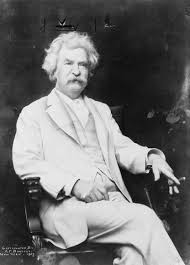
Mark Twain believed in the supernatural, apparitions, and loved a Catholic Saint.
Mark Twain, to the surprise of almost everyone, wrote a book, a biography no less, about the life and times of Joan of Arc. The book is call the "Personal Recollections of Joan of Ark" and astonishingly he called this virtually unknown volume his "best and favorite work".
Author Randall Sullivan told us recently in an e-mail
"Thanks for your letter regarding my book, The Miracle Detective. I was simultaneously stirred and chagrined by what you wrote about Mark Twain and his Joan of Arc book. I have to admit that I was among those who did not know that Twain had authored such a book, let alone that he considered it his most important work."
There are intriguing reasons why most folks are unaware of the beliefs of Mark Twain, but first here are the remarkable words from Mark Twain about a book he wrote about a Catholic Saint.
"I like Joan of Arc best of all my books; and it is the best; I know it perfectly well. And besides, it furnished me seven times the pleasure afforded me by any of the others; twelve years of preparation, and two years of writing. The others needed no preparation and got none."
Mark Twain admired, maybe even venerated “Joan of Arc" and he was transfixed by the amazing spiritual events experienced by the young French virgin who called herself "Joan the Maid"
Mark Twain spent twelve years researching and writing his book.
Twain went to the National Archives of France and read through the transcripts of the trial that ended in Joan's martrydom, as well as the inquisition — held 25 years after her death — that cleared her name. He studied both English and French accounts of the French heroine, and concluded, in an essay(read the entire essay here) he wrote in 1904 that Joan was the "Wonder of the Ages," an individual "stainlessly pure, in mind and heart, in speech and deed and spirit."
Mark Twain said:“Taking into account, as I have suggested before, all the circumstances -- her origin, youth, sex, illiteracy, early environment, and the obstructing conditions under which she exploited her high gifts and made her conquests in the field and before the courts that tried her for her life, -- she is easily and by far the most extraordinary person the human race has ever produced".
"The most extrodinary person the human race has ever produced", certainly high praise for a Catholic Saint from Mr. Twain.
Edward Wagenknecht in his biography , "Mark Twain: The Man and His Work" said of Mark Twain's labor:
"It is an extraordinary (and baffling) literary phenomenon that Mark Twain, who was not disposed to see God at work in the melancholy affairs of men, should have been so galvanized by the life and achievement of this young woman that he devoted years of his life to this book about her."
Thomas Howard, Author, ""Chance or the Dance? weighed in with:
"Mark Twain comes furtively like Nicodemus at night with this tribute to one of God's saints. In doing so he tells a secret about himself. It is as though the man in a white suit and a cloud of cigar smoke thought there just might be a place where people in white robes stand in clouds of incense."
But it is in Mark Twain's remarkable essay where we see in his own words his special relationship and love for Joan of Arc:
"There is no blemish in that rounded and beautiful character.
She was deeply religious, and believed that she had daily speech with angels; that she saw them face to face, and that they counselled her, comforted and heartened her, and brought commands to her direct from God. She had a childlike faith in the heavenly origin of her apparitions and her Voices, and not any threat of any form of death was able to frighten it out of her loyal heart. She was a beautiful and simple and lovable character.
Her history has still another feature which sets her apart and leaves her without fellow or competitor: there have been many uninspired prophets, but she was the only one who ever ventured the daring detail of naming, along with a foretold event, the event's precise nature, the special time-limit within which it would occur, and the place -- and scored fulfilment.
At Vaucouleurs she said she must go to the King and be made his general, and break the English power, and crown her sovereign -- "at Rheims." It all happened. It was all to happen "next year" -- and it did. She foretold her first wound and its character and date a month in advance, and the prophecy was recorded in a public record-book three weeks in advance. She repeated it the morning of the date named, and it was fulfilled before night.
At Tours she foretold the limit of her military career -- saying it would end in one year from the time of its utterance -- and she was right. She foretold her martyrdom -- using that word, and naming a time three months away -- and again she was right.
At a time when France seemed hopelessly and permanently in the hands of the English she twice asserted in her prison before her judges that within seven years the English would meet with a mightier disaster than had been the fall of Orleans: it happened within five -- the fall of Paris. Other prophecies of hers came true, both as to the event named and the time-limit prescribed."
Finally one of our favorite passages from Twains' essay:
"asked at her trial why it was her standard (The standard depicts the Virgin Mary and two angels) had a place at the crowning of the King in the Cathedral of Rheims rather than the standards of the other captains, she uttered that touching speech, "It had borne the burden, it had earned the honor" -- a phrase which fell from her lips without premeditation, yet whose moving beauty and simple grace it would bankrupt the arts of language to surpass."
"Bankrupt the arts of language to surpass" Again high praise from one of America's finest writers.
But of course the main stream media will have none of Mark Twain's journey into the supernatural. The media, book critics , and academia have kept Mark Twain's views of this Catholic Saint a virtual secret for years. Most reviews of the book dismiss the work as insignificant.
Atheists, agnostics and "intellectuals" have employed Mark Twain's wit to ridicule organized religion for decades , they are beholden to this notion and so they are not about to sully the waters with a spiritual view of Mark Twain. The atheists love to quote Mark Twain's famous quip "It ain't those parts of the Bible that I can't understand that bother me, it is the parts that I do understand."
We have no doubt Mark Twain was quite scornful of many aspects of organized religion in his day. Who is not from time to time. The Ted Haggards, the Mark Stanfords, the Jimmy Swaggerts and all the hypocrits deserve to be pilloried.But the Atheists, the purveyors of logic and reason, refuse to have a balanced view of Twain. They reverentially genuflect at Twain's derision of people of faith, but they quickly label him a fool when he finds beauty and virtue in a religious figure.
The Atheists can not accept Mark Twain's book about a Saint, as worthy of his talents, particularly a book about a Catholic religious figure that claims to have been guided by apparitions, angels and Saints.
Mark Twain was fully aware that Joan of Arc was exceptionally pious. She required her soldiers to take the Sacraments of Confession and Communion regularly and she would have her men of her army gather around for daily prayer and devotion. Mark Twain knew all this. He also understood that she believed all that she accomplished was possible only through God's intervention and to the dismay of the Atheists, Mark Twain does not quibble with any of her testimony.
She is the Wonder of Ages.
Below is a fascinating story of Mark Twain and "Joan of Arc" from the New York Times from 1905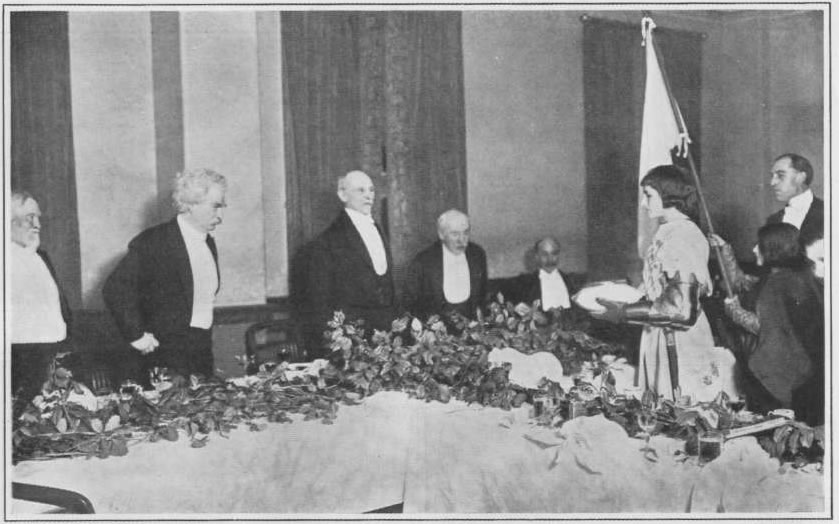
Left to Right: Andrew Carnegie, Mark Twain, Dan Beard, Sir C. Purdon Clarke, Rollo Ogden, Miss Angersten
This photo of the event appeared in the December 31, 1905 edition of The New York Times, Pictorial Section.
Mark Twain was the guest of honor at a dinner given last night at the Aldine Association by the Society of Illustrators. All the well-known magazine and newspaper artists were present, while other distinguished guests included Andrew Carnegie, Sir. C. Purdon Clarke, Caspar Whitney, Robert Collier, Jr., Norman Hapgood, Alphonse Mucha, Arthur Scribner, and Thomas A. Janvier, Frederick Remington, Henry S. Fleming, and Daniel Beard were on the Reception Committee.
It had been arranged that when the humorist arose to speak Miss Angersten, a well-known model, was to appear in the garb and with the simple dignity of Jean d'Arc, his favorite character in all history. He was on his feet as Jean d'Arc entered the room. She wore the armor of the French heroine and her hair and face made a strangely appealing picture.
The face of the humorist, which had been wearing its "company" smile all night, suddenly changed. He had every appearance of a man who had seen a ghost. His eyes fairly started out of his head, and his hand gripped the edge of the table.
Jean d'Arc presented him with a wreath of bay. He merely bowed, with his eyes fixed on the girl's face. They followed her as in reverent silence she passed out, followed by a little boy in suitable costume, bearing a banner over her head. Then Mark Twain spoke. His voice was broken, and his word came slowly.
There's an illustration, gentlemen - a real illustration," he said. "I studied that girl, Joan of Arc, for twelve years, and it never seemed to me that the artists and the writers gave us a true picture of her. They drew a picture of a peasant. Her dress was that of a peasant. But they always missed the face - the divine soul, the pure character, the supreme woman, the wonderful girl. She was only 18 years old, but put into a breast like hers a heart like hers and I think, gentlemen, you would have a girl - like that."
The humorist looked toward the door, and there was absolute silence - puzzled silence - for many did not know whether it was time to laugh, disrespectful to giggle, or discourteous to keep solemn. The humorist realized the situation. Turning to his audience he came out of the clouds and said solemnly:
"But the artists always paint her with a face - like a ham."

 Ernest Hemingway's hero, Santiago, the fishing captain from his famous book, Old Man and the Sea, prays: Hail Mary, and Our Father. These are the prayers Santiago recites ‘should I catch this fish’. Santiago also promises to make a pilgrimage to the Virgin De Cobre (Our Lady of Charity from Cuba) if he catches the fish.

